 Poygan Tech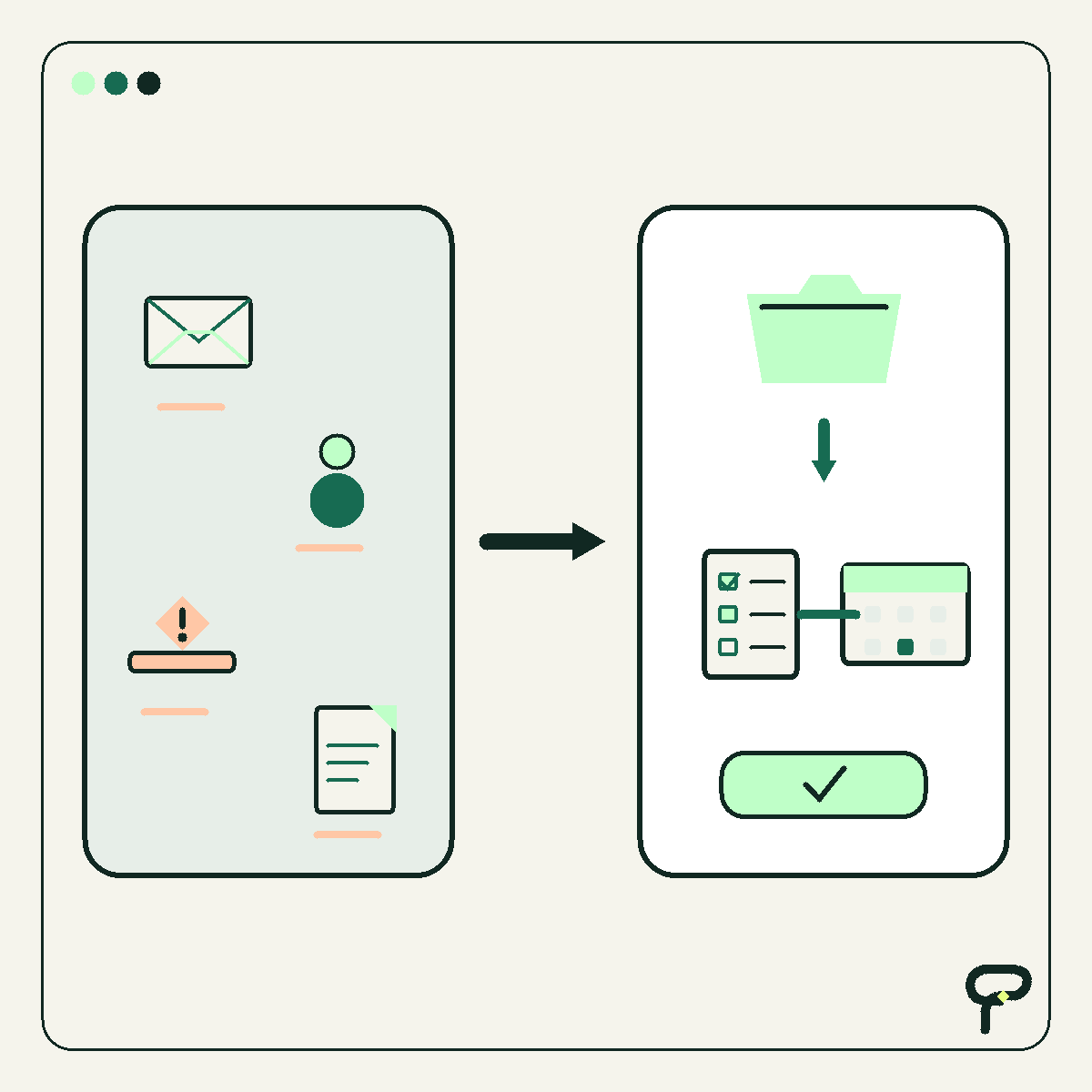
An email can look like a request without being ready for work. It may come from an unfamiliar address, omit the deadline, repeat an earlier message, or contain a promise that only a person should approve. Copying every message directly into a task tracker would make the inbox quieter, but it would also move uncertainty into a different box.
For this build note, I would treat email as the beginning of intake, not as the work item itself. The design below is a hypothetical, synthetic example. It does not describe a Poygan customer or claim measured results. Its purpose is to show how I would automate email requests into task tracking while keeping ownership, exceptions, and customer commitments visible.
Start with a small intake contract
Before connecting an inbox to a task system, I would define what qualifies as a usable request. In this hypothetical workflow, every work item needs a requester, a short description, an affected customer or project, a requested outcome, and any timing information the sender supplied. A requested date is not automatically an approved deadline.
I call this an intake contract: the minimum information and rules needed before ordinary work can begin. It does not need to be a formal legal document. It can be a one-page table that names each field, explains where it comes from, says whether it is required, and identifies who resolves ambiguity.
Email standards distinguish several pieces of message identity, including From, Sender, Message-ID, In-Reply-To, and References. That matters because a display name is not a sufficient business authorization rule, and a reply chain is not necessarily a new request. The automation can read those fields, but the business still has to decide which senders and request types it accepts.
- Requester: the normalized email address and displayed name.
- Request: a concise description derived from the subject and body without changing the sender's meaning.
- Context: the customer, project, location, order, or other record the request concerns.
- Requested timing: what the sender asked for, preserved separately from any approved commitment.
- Source reference: the mailbox, received time, and message identifier used for traceability.
The before state: an email that can disappear into interpretation
Imagine a synthetic message with the subject “Need this changed by Friday.” The body mentions a website photo, but it does not identify the page. The sender appears to be Pat at a familiar company, although the address uses a domain the team has not recorded. A colleague forwarded a similar message yesterday.
A person can investigate all of that, but the investigation is usually invisible while the message remains in an inbox. Someone may assume another person handled it. A second person may create a duplicate task. Worse, an automatic reply might accidentally make Friday sound confirmed.
The useful automation is not “email arrives, therefore task exists.” It is “email arrives, therefore the request receives a visible state.” That state might be ready, waiting for information, possible duplicate, unrecognized sender, or awaiting human approval.
The gate: validate, compare, and classify
First, I would validate the sender against business records. A known address connected to the relevant customer or project can continue through normal intake. An unfamiliar address, a mismatch between the visible identity and address, or a sender without permission for that request type goes to review. This is a routing decision, not a claim that email identity has been proven.
Next comes duplicate detection. The Message-ID field is intended to identify a particular message, so I would store it and reject an exact replay that has already been processed. For replies and forwards, I would also retain the thread reference fields described by the email standard. Those fields help with grouping, but I would not treat a shared thread as proof that two requests are identical.
A second, conservative comparison can look for the same sender, customer or project, normalized subject, referenced record, and a nearby received time. A strong match should produce a “possible duplicate” flag rather than silently deleting either request. False merging is expensive because it can hide legitimate work.
Then I would check the intake contract. Missing project context or an unclear requested outcome sends the item to an exception queue. The original message remains attached or linked, and extracted text remains distinguishable from any staff correction. An AI model could suggest field values, but uncertain suggestions should not become facts merely because they fit neatly into a form.
- Accept known and authorized requesters into the normal path.
- Route unfamiliar or mismatched senders to human review.
- Block exact reprocessing using the stored message identifier.
- Flag probable duplicates using several matching signals.
- Send incomplete or ambiguous requests to a visible exception queue.
The after state: one record with an owner and an honest acknowledgement
Once the request passes the gate, the system creates one work item with a stable internal identifier. It stores the source reference, captured fields, intake status, and decision history. Assignment follows an explicit rule such as customer owner, project owner, request category, or a designated intake queue. If no rule produces exactly one valid owner, the work item stays unassigned in an exception state instead of choosing someone arbitrarily.
The acknowledgement should say only what the system knows. A safe version is: “We received your request and recorded it as R-1042. A person will review the requested timing.” That confirms receipt and provides a reference without confirming price, scope, feasibility, or completion date.
The customer promise is a separate controlled step. A person reviews the request, capacity, dependencies, and requested timing. That person may then approve a commitment, propose a different date, ask a question, or decline the work. The approved promise, approver, and approval time are recorded separately from the sender's original request.
This separation is small but important: receipt is a system fact; commitment is a business decision. The automation may prepare a reply, but it should not send language that commits the team until the designated person approves it.
Design the exception path before celebrating the happy path
Exception handling is part of the workflow, not a failure outside it. I would give each exception an owner, reason, next action, and review time. Useful reasons include unknown sender, missing required field, possible duplicate, no assignment match, unsafe attachment, extraction uncertainty, and customer promise awaiting approval.
I would also make recovery explicit. When a person verifies the sender, supplies the missing project, or decides that two messages are separate requests, the record should re-enter the workflow without requiring someone to copy everything into a new task. The history should show what changed and who changed it.
Finally, I would test with synthetic examples before connecting a live inbox: an exact replay, a reply that adds new work, a forwarded request, two customers with similar names, an absent project number, an out-of-office response, and a request containing an aggressive deadline. The goal is not to prove that no unusual email will appear. It is to confirm that uncertainty becomes visible instead of being converted into a confident mistake.
A practical build sequence
I would begin with observation mode. The workflow reads a test mailbox and proposes records without creating tasks or sending replies. A person compares each proposal with the source message and records where the rules fail.
Next, I would allow task creation while keeping acknowledgements manual. After the team is comfortable with sender validation, duplicate flags, required fields, assignment, and exception recovery, a narrow receipt acknowledgement can be automated. Customer commitments remain behind explicit human approval.
That staged approach makes the design easier to inspect. It also produces a better question than “Did the automation run?” The better question is “Can we see what it understood, what it could not decide, who owns the next action, and whether a person approved the promise?”
Useful takeaways
- Treat email as an intake trigger, not as a completed work item.
- Define required fields and accepted senders before building the connection.
- Store the email Message-ID for exact replay control, then use multiple signals to flag possible duplicates conservatively.
- Give incomplete, ambiguous, or unassignable requests a visible exception state with an owner and recovery path.
- Separate acknowledgement of receipt from approval of scope, price, feasibility, or deadline.
- Keep customer promises behind a named human approval step and record that decision.
One next thought
If your team is manually translating inbox messages into tasks, map one real request from arrival through acknowledgement and mark every place where a person is still making an important decision. That map is a sensible starting point for a small, reviewable P
ONE EMAIL · PERSONAL REPLY
Let’s find the right first step.
Leave your email. I’ll reply personally and help you figure out where to start.